26 Jul
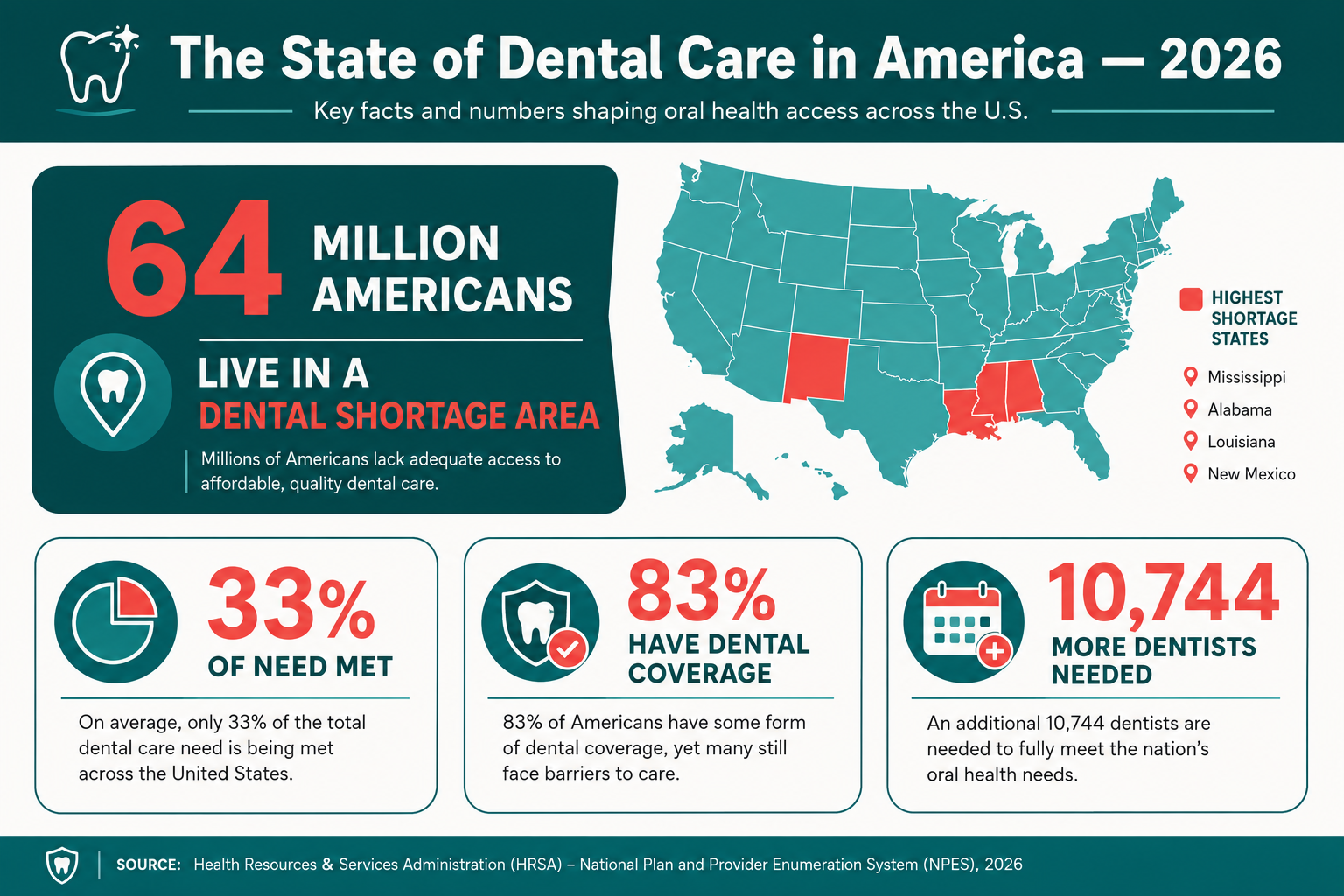
Nearly 64 million Americans live in an area the federal government has officially designated as short on dentists, and even for people with dental insurance, that shortage is now a bigger barrier to care than cost. If you’ve ever waited weeks for a new-patient appointment, been told a practice “isn’t accepting new patients,” or driven 30+ minutes just to find someone in-network, you’re not imagining it. It’s a documented, worsening, state-by-state problem — and this piece breaks down exactly where it’s worst, why insurance alone doesn’t fix it, and what actually works when you’re trying to find a dentist near you right now.
Why We’re Looking at This Right Now
Every year we help people navigate the same frustrating search: find a qualified dentist nearby who’s actually taking new patients. Doing that at scale across hundreds of U.S. cities means we see the access gap up close, some cities have a dozen well-reviewed practices within a few miles; others have almost none within a 45-minute drive. So we pulled the latest federal shortage-area data and national insurance enrollment figures to put real numbers behind what our own directory search patterns have been showing for months: the gap between “having insurance” and “actually getting an appointment” is widening.
This isn’t an abstract policy issue. It shows up as very concrete frustrations: a receptionist telling you the next new-patient opening is two months out, a plan’s “in-network” list including a practice that closed last year, or a family driving to a neighboring town because nobody local has room. Those experiences are individually easy to dismiss as bad luck. Lined up against national shortage data, they’re clearly part of a documented pattern.
How This Compares to Where Things Stood a Few Years Ago
Dental access hasn’t collapsed suddenly — it’s been drifting in this direction for a while. Dental benefits enrollment peaked at 88% of the population in 2022 and has ticked downward each year since, landing at 83% in the most recent report. Meanwhile, shortage-area designations have stayed persistently in the thousands rather than shrinking, even as awareness of the problem has grown. Put simply: the country isn’t losing ground catastrophically, but it isn’t closing the gap either, access has essentially plateaued at a level that leaves tens of millions of people underserved.
The National Picture: How Big Is the Access Gap, Really?
According to the Health Resources and Services Administration (HRSA), the federal agency responsible for tracking healthcare access, the United States currently has 7,443 designated Dental Health Professional Shortage Areas (HPSAs) — geographic regions, population groups, or facilities where there simply aren’t enough dentists to meet demand.
- Over 63.7 million Americans live inside a designated dental shortage area
- Only about 33% of the dental need in those areas is currently being met
- HRSA estimates the country would need roughly 10,744 more dental practitioners just to eliminate existing shortage designations
You can look up any address directly using HRSA’s HPSA Find tool, or see the national rollup on KFF’s State Health Facts dental shortage tracker.
To put that in perspective: dental shortage designations now cover a population roughly the size of France or the United Kingdom. And unlike a temporary staffing dip at a single practice, an HPSA designation reflects a structural, region-wide imbalance between the number of practicing dentists and the population that needs care — one that typically takes years, not months, to resolve, since it depends on new dentists choosing to set up practice in underserved areas.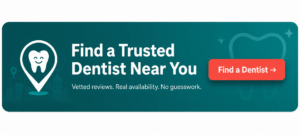
What’s Actually Driving the Shortage
A few compounding factors show up consistently in workforce data:
- Uneven distribution — new dental school graduates disproportionately settle in already well-served metro areas rather than rural or lower-income regions
- An aging dentist workforce in many rural counties, with fewer younger dentists taking over as older practitioners retire
- Reimbursement gaps — Medicaid dental reimbursement rates in many states remain low enough that a meaningful share of practices limit how many Medicaid patients they accept
- Rising practice overhead costs, which make it harder for solo and small practices to stay open in lower-density areas
None of these are quick fixes, which is exactly why the shortage-area map has stayed fairly consistent year over year rather than closing on its own.
Insurance Coverage Doesn’t Close the Gap the Way You’d Expect
It’s tempting to assume this is purely an insurance problem — but the data says otherwise.
According to the National Association of Dental Plans’ 2025 Dental Benefits Report, roughly 284 million Americans — about 83% of the population — currently have some form of dental benefit. That’s actually a decline of 2.3% from the year before, driven by drop-off in both commercial and publicly funded plans.
Here’s the disconnect: having a dental plan tells you nothing about whether there’s an in-network dentist within a reasonable distance who’s actually accepting new patients. DPPO plans dominate the commercial market, but network adequacy varies enormously by region — which is exactly why “I have insurance” and “I can get an appointment this month” have become two very different problems.
Where the Gaps Are Worst
Shortage areas aren’t spread evenly.
California currently has 565 designated dental shortage areas — more than any other state, according to HRSA data. And the gap skews heavily rural: more than 63% of geographic dental shortage designations nationally fall in rural areas, even though rural regions hold a much smaller share of the U.S. population.
What that means in practice: two people with identical insurance plans, one in a well-served metro area and one in a shortage-designated rural county, are going to have wildly different experiences trying to book a routine cleaning — let alone an urgent appointment.
What This Means If You’re Searching for “Best Dentist Near Me” Right Now
If you’ve been struggling to find an available dentist, the data above is the honest reason why — it’s rarely about you “not looking hard enough.” It’s a structural, well-documented access gap, and it’s exactly the problem a directory like ours is built to shortcut.
Instead of cold-calling a dozen practices to find who’s actually taking patients, you can start with a pre-vetted list — for example, our breakdown of the best-reviewed dentists in Denver, CO, or similar city guides we maintain across the country. We built these specifically because generic search results don’t tell you who’s actually available.
This matters even more in shortage-adjacent metro areas, where a handful of practices absorb most of the demand. Checking availability and network status before you call saves the exact kind of wasted time this data shows is becoming more common nationally.
How to Actually Vet a Dentist, Wherever You Live
Whether you’re in a well-served city or a shortage area, the vetting process should look the same:
- Confirm they’re accepting new patients before you get attached to the idea — call or check current status, don’t assume a listing is up to date
- Verify in-network status directly with your insurer, not just the practice’s website
- Look at review volume and consistency over time, not just the star average — a handful of 5-star reviews means far less than hundreds with a stable pattern
- Ask about wait times for both routine and urgent appointments upfront
- For shortage-area residents specifically, ask whether the practice partners with any sliding-scale, FQHC, or dental-school clinic options as a backup
It’s also worth asking how a practice handles same-day emergencies, since that’s a strong practical indicator of overall capacity — a practice that’s genuinely overbooked will usually be upfront that they can’t fit in urgent cases quickly, while one with more room will often hold a slot or two open specifically for that purpose.
A quick pre-appointment checklist
- Call (don’t just check the website) to confirm new-patient status
- Confirm in-network status with your insurer directly, using the practice’s exact billing name
- Ask for the soonest available routine appointment, and separately, the soonest emergency slot
- Check review recency — a practice with great reviews from three years ago and none since may have changed hands or declined
- Ask what happens after hours if you have a dental emergency
If you want a shortcut through this entire process, that’s the exact gap the right directory is built to close.
That’s what DenScore’s directory is designed for — real, current availability and vetted reviews in one place, instead of a dozen open browser tabs.
The Bottom Line
Nearly 64 million Americans live somewhere the federal government has already confirmed doesn’t have enough dentists. Insurance coverage, while still important, isn’t closing that gap — and the states and regions most affected skew rural and lower-income, where the consequences of delayed care compound over time: untreated issues that start small tend to become the expensive, urgent kind precisely because routine care was out of reach. If you’re feeling this gap firsthand, you’re seeing a real, measured national trend play out locally, not a personal failure to find the right practice.
The fastest way through it is starting your search with a source that already knows who’s actually available near you, rather than working through a list of practices one cold call at a time.
Find a Vetted Dentist Near You →
|
DenScore Directory
Top Dentists — Denver, CO
|
|
Aspen Dental
Dr. Laura Noce, DMD, MSc
3300 E 1st Ave Unit 300, Denver, CO 80206
|
|
Charisma Family Dentistry
Dr. Jesus Loza Salinas, DDS
1880 S Pierce St #16B, Lakewood, CO 80232
|
|
Signature Dentistry of Denver
Dr. David Bennett, DDS
|
| See Full Top 30 List → |
Frequently Asked Questions
What is a Dental Health Professional Shortage Area (HPSA)?
It’s an official federal designation from HRSA identifying a geographic area, population group, or facility where the ratio of dentists to residents falls below the threshold needed to meet demand. As of the most recent report, there are 7,443 such designations across the U.S.
Which state has the worst dentist shortage?
California currently has the most designated dental shortage areas of any state, at 565, according to HRSA data — though shortage severity varies significantly by county even within well-served states.
Does having dental insurance guarantee I can find a dentist nearby?
No. About 83% of Americans have some form of dental benefit, but coverage doesn’t account for network adequacy — whether an in-network provider near you actually has open appointment slots. Insurance and access are related but separate problems.
Why is it harder to find a dentist in rural areas?
More than 63% of geographic dental shortage designations are in rural areas. Lower population density makes it harder for practices to stay financially viable, and fewer new dentists choose to set up rural practices after graduation.
How can I find out if I live in a dental shortage area?
HRSA provides a free public lookup tool where you can enter your address and see current shortage designations for your area.
What should I do if I can’t find a dentist accepting new patients?
Check for FQHC (Federally Qualified Health Center) locations near you, ask your insurer for an updated in-network list (online directories are often outdated), and consider dental school clinics, which often accept new patients at reduced rates.
Is the dentist shortage getting better or worse?
Recent NADP data shows dental benefits enrollment actually declined 2.3% in the most recent reporting year, and HRSA’s shortage designations remain in the thousands — so on current data, the gap is not meaningfully closing.
Does a dentist shortage affect wait times even in big cities?
Yes, though less severely than in rural shortage areas. Even well-served metro areas can have pockets of high demand where popular, well-reviewed practices book out weeks in advance — which is why checking real-time new-patient availability matters everywhere, not just in officially designated shortage regions.