30 Jul
A fake review usually gives itself away in the pattern, not any single word: a burst of five-star ratings posted within days of each other, vague praise with no specific detail about the actual visit, or a reviewer account with exactly one review ever posted. If a dentist’s profile shows several of these patterns at once, that’s a stronger signal than any individual red flag — and it’s worth knowing before you book, not after.
Why Fake Reviews Are a Bigger Problem in Healthcare Than in Most Industries
Choosing a dentist isn’t like choosing a restaurant. A bad meal costs you an evening; a bad dentist can cost you money, pain, and in some cases your long-term oral health. That higher stakes environment is exactly why review manipulation in healthcare deserves more scrutiny than the average product review, yet most people vet a dentist’s reviews the same casual way they’d vet a coffee shop.
It’s also a market where manipulation is unusually easy to get away with. Restaurant and retail reviews get cross-checked constantly by repeat customers who eat there again next week. A dental visit, by contrast, might happen once every six months to a year, which means there are fewer regular patients around to notice if a practice’s review profile suddenly looks off, and far more time between visits for a manipulated rating to sit unchallenged.
Across the hundreds of city-level dentist directories we maintain, from larger metro markets to smaller cities, the same handful of manipulation patterns show up again and again, regardless of location. That repetition across otherwise unrelated markets is itself informative, it suggests these aren’t isolated bad actors, but a fairly standardized set of tactics being reused.
The Real Scale of the Fake Review Problem
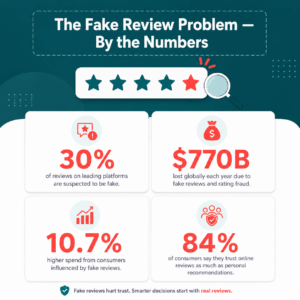
This isn’t a fringe issue. Independent research puts hard numbers behind what many patients already suspect:
- Roughly 30% of all online reviews across major platforms are estimated to be fake or manipulated in some way
- That manipulation is estimated to cost consumers around $770.7 billion globally in 2025 alone
- Google carries the highest share of potentially fake reviews among major platforms, at roughly 10.7%, ahead of Yelp (7.1%), Tripadvisor (5.2%) and Facebook (4.9%)
- Google itself reported removing over 170 million policy-violating reviews in a single recent year, a 45% increase over the year before
(Sources: BrightLocal’s Online Review Statistics research, compiling data from Uberall’s State of Online Review Fraud study and Google’s own reporting.)
Why the FTC’s Fake Review Ban Matters for You
This is no longer just a platform-policy issue, it’s federal law. The Federal Trade Commission’s Consumer Review Rule, which took effect in October 2024, makes it illegal for a business to buy, sell, or otherwise procure fake reviews, and it specifically covers AI-generated reviews, undisclosed insider reviews, and the practice of quietly hiding negative feedback.
The rule gives the FTC authority to seek civil penalties in excess of $51,744 per violation, and the agency has already started using it: in December 2025, the FTC issued its first wave of warning letters to companies suspected of non-compliant review practices, a clear signal that enforcement is ramping up, not staying theoretical.
For patients, the practical takeaway is simple: the existence of this rule confirms fake reviews are common enough, and harmful enough, to warrant federal regulatory action. That’s a strong reason to actually check before booking, rather than assuming platforms have already filtered the problem out for you.
What Trusting a Manipulated Rating Actually Costs You
The consequences of picking a dentist based on an inflated rating aren’t hypothetical. At the mild end, it’s wasted time: booking with a practice that turns out to have long unstated wait times, or a bait-and-switch pricing structure, because the glowing reviews never mentioned either. At the more serious end, it can mean lower-quality clinical work, unnecessary procedures recommended, or corners cut on technique, that only becomes obvious well after the fact, sometimes not until a second dentist points it out during an unrelated visit.
There’s also a compounding cost that’s easy to miss: choosing badly once often means a longer gap before your next visit, simply because the experience was frustrating enough to put you off going back anywhere for a while. Given how much dental problems tend to escalate in cost and complexity the longer they go unaddressed, that delay is arguably the most expensive part of the whole scenario, not the wasted appointment itself, but everything that gets postponed afterward.
This is exactly why review vetting deserves a few extra minutes rather than a quick glance at the star average. The stakes of getting it wrong compound quietly, in ways that don’t show up until much later.
How Much Reviews Actually Drive Healthcare Decisions
It’s worth being clear about how much weight is actually riding on this. Research consistently shows reviews aren’t a minor factor in choosing a provider, they’re often the deciding one.
A 2025 patient survey from rater8 found that 84% of patients check online reviews before selecting a new healthcare provider, and more than half read at least six reviews before deciding. Perhaps more strikingly, 61% of patients said they’d prioritize online reviews over a personal recommendation from a friend or family member, a full reversal of how referrals used to work.
Separate research from RepuGen’s 2025 Patient Review Survey backs this up: 73% of patients consider reviews when choosing a provider, and over 91% of those patients place at least a moderate level of trust in what they read. Interestingly, the same survey found 55% of patients will overlook some negative feedback if the overall rating is high enough, which is exactly the psychology a cluster of fake 5-star reviews is designed to exploit.
Why This Matters Specifically for Dental Care
Dentistry isn’t just “healthcare in general” when it comes to reviews, research focused specifically on dental patients shows some distinct patterns worth knowing.
Top Studies:
A mixed-methods study published via the National Institutes of Health (NIH/PMC) examining patient reviews of dental care found that 59% of respondents considered patient review websites important when choosing a provider, 35% said they selected a dentist specifically because of good ratings, and 37% said they avoided a provider because of bad ones. Nearly 90% rated the presence of accepted-insurance information on a listing as highly important, reinforcing why checking in-network status alongside review authenticity matters so much (something we cover across our dental insurance guides).
Put together, the research paints a consistent picture: dental patients lean on reviews heavily, they use insurance-network information as a major filter alongside ratings, and a meaningful share of them are willing to look past a few negative reviews if the overall picture looks strong enough, which is precisely the vulnerability fake-review clusters are built to take advantage of.
The FTC’s rule specifically calls out AI-generated reviews because the technology has made large-scale review fabrication dramatically cheaper and faster than the old approach of paying real people to write them. A few years ago, generating a hundred fake reviews meant recruiting a hundred people; today it can mean running a script.
Consumers have started adjusting their own filtering as a result: research shows roughly 46% of consumers will assume a review is fake if they suspect it was written by AI, and the way a review is phrased has become one of the top signals people use to judge authenticity, ahead of star rating alone. That’s a useful instinct to lean on: reviews that sound slightly too polished, too generic, or oddly repetitive in structure across multiple posts are worth a second look.
Patterns We See Across Our City Guides
Because we maintain dentist directories across hundreds of U.S. cities, from larger metros like our guides to
Jacksonville, FL, San Diego, CA, and Tulsa, OK, to smaller regional markets like our guide to Bowling Green, KY,we’re in a position to compare review patterns side by side rather than looking at one practice in isolation.
A few consistent observations from that comparison:
- Review volume and rating alone tell you very little without checking timing and specificity, a practice with 40 reviews spread evenly over three years reads very differently from one with 40 reviews posted in a single month
- Smaller markets tend to have fewer reviews overall, which paradoxically makes a manipulated cluster easier to spot, a sudden jump from 5 reviews to 50 in a matter of weeks stands out more in a smaller city than in a dense metro market
- Larger metro markets see more review volume overall, so vetting for specificity and reviewer history becomes more important than raw star rating, since a high volume of generic reviews can mask a thinner base of genuinely detailed feedback
None of this means you need to become a forensic reviewer before booking a cleaning, it just means treating the star rating as a starting point, not the whole picture.
These are the patterns that show up most consistently, across markets and specialties alike:
- A cluster of 5-star reviews posted within the same few days, especially after a quiet stretch with no reviews at all
- Vague, generic praise with no mention of a specific procedure, staff member, or detail about the actual visit (“Great place, highly recommend!” and nothing else)
- A reviewer profile with only one review ever posted, and no other review history on the platform
- Multiple reviews using strikingly similar phrasing or sentence structure, as if written from the same template
- A profile with an unusually high volume of 5-star reviews and literally zero critical or even neutral ones, real practices, like anything else, tend to accumulate at least a few mixed reviews over time
- Reviews that read like they’re describing a different type of business entirely (leftover template language from unrelated industries)
Why a “Perfect” 5.0 Rating Should Actually Make You a Little Suspicious
It sounds counterintuitive, but a flawless rating isn’t necessarily the strongest trust signal, researchers have found it can actually be a weaker one.
Research from Northwestern University’s Spiegel Research Center has found that products and businesses rated between 4.2 and 4.5 stars tend to build more consumer trust and better long-term loyalty than those with a perfect 5.0, largely because a spotless record reads as too good to be true. Separate consumer research backs this up directly: nearly half of shoppers say they distrust a perfect 5-star rating, a number that climbs even higher among younger consumers.
The practical implication: a dentist with a 4.6 and a handful of mixed, detailed reviews is often a safer bet than one with a suspiciously flawless 5.0 and almost no review depth.
How to Vet a Dentist’s Reviews Before You Book
A quick, repeatable process beats a gut reaction every time:
- Sort by “most recent” rather than relying on the default sort, and check whether reviews are actually spread out over time or clustered in short bursts
- Click into a few reviewer profiles, a real local reviewer usually has other reviews for other local businesses, not just one review ever posted
- Look for reviews that mention specific details: a named staff member, a specific procedure, a real wait-time experience, specificity is hard to fake at scale
- Read a few of the lowest-rated reviews, not just the top ones, how (and whether) a practice responds tells you a lot about how they’ll treat you if something goes wrong
- Cross-check the rating across more than one platform rather than trusting a single source
A quick example of how this plays out
Imagine two practices with an identical 4.8-star average. One has 200 reviews posted steadily over four years, several mentioning specific staff members and procedures, with a handful of 3-star reviews the practice responded to professionally. The other has 180 reviews, most posted within the last two months, heavy on generic phrases like “amazing experience” with no other detail, and zero reviews below 5 stars. Same rating, very different level of confidence you should place in it.
If you’d rather skip this manual process entirely, that’s exactly what our dentist-near-me search is built for, every listing is checked for these same review-authenticity patterns before it’s surfaced to you.
What DenScore Does Differently
Review authenticity is one of several factors we weigh when evaluating a dental practice, alongside professional qualifications, scheduling flexibility, and patient feedback consistency over time, not just a single star average.
You can read more about how our evaluation process works on our About Us page, or meet the people behind it on our Team page. We also maintain a dedicated Reviews resource covering how patient feedback factors into our rankings.
This same vetting approach carries through every city guide we publish, whether you’re checking practices in a major metro area or a smaller city, the same authenticity checks apply before a dentist is recommended.


The Bottom Line
Fake reviews are a documented, federally regulated problem, not a fringe concern, and not something you should assume a platform has already filtered out for you. A few extra minutes checking reviewer history, review timing, and specificity can save you from booking with a practice that’s manipulating its reputation rather than earning it.
Ready to skip the manual review-vetting process? Find a trusted dentist near you through DenScore, or start from our homepage to browse by city.
Frequently Asked Questions
How can you tell if a dentist’s reviews are fake?
Look for clusters of 5-star reviews posted in a short time span, vague praise with no specific detail, reviewer profiles with only one review ever, and near-identical phrasing across multiple reviews. Any single sign can be a coincidence; several together are a stronger warning.
Is it illegal for a business to buy fake reviews?
Yes. Under the FTC’s Consumer Review Rule, effective since October 2024, businesses are prohibited from buying, selling, or otherwise procuring fake reviews or testimonials, including AI-generated ones, with civil penalties available for violations.
Why would a perfect 5-star rating be a red flag?
Research shows consumers tend to trust ratings in the 4.2-4.5 range more than a flawless 5.0, since a spotless record with zero critical reviews often reads as manufactured rather than earned. Genuine businesses typically accumulate at least some mixed feedback over time.
What percentage of online reviews are fake?
Independent research estimates roughly 30% of all online reviews across major platforms are fake or manipulated in some way, with Google carrying the highest share among major platforms at around 10.7%.
Does Google remove fake reviews?
Google does actively remove policy-violating reviews, it reported taking down over 170 million in a recent year alone, but the volume of removals also indicates how large the underlying problem is, so relying solely on platform moderation isn’t a complete safeguard.
What should I do if I suspect a dentist has fake reviews?
Check reviewer profiles for review history, look at how the practice responds to lower-rated reviews, and cross-check the rating on a second platform before booking. You can also report suspected fake reviews directly to the platform.
Are review authenticity checks part of how DenScore ranks dentists?
Yes. Review pattern consistency is one of several factors we consider alongside professional qualifications, scheduling flexibility, and patient feedback when evaluating dental practices for our directory.
Should I avoid a dentist just because they have a few negative reviews?
Not necessarily. A handful of mixed or negative reviews, especially ones the practice responded to professionally, is often a sign of an authentic review history rather than a red flag. A complete absence of any critical feedback is more worth questioning than the presence of a few.
How many dental patients actually rely on reviews to choose a provider?
Research specific to dental care found that 59% of patients consider review websites important, 35% chose a dentist specifically because of good ratings, and 37% avoided a dentist because of bad ones, making review authenticity a meaningfully high-stakes issue for patients, not a minor detail.