Dental insurance can be valuable if you regularly use preventive services such as cleanings and routine checkups, which are often fully covered. It can also help reduce costs if you expect to need more expensive treatments like crowns or root canals. For patients who use their two covered cleanings annually and have even one restorative procedure per year, a standard dental PPO typically pays for itself. The value decreases if you need major work exceeding your annual maximum. For entirely healthy adults who rarely need treatment, evaluating whether the premium exceeds expected out-of-pocket costs is a reasonable exercise — but the risk protection alone often justifies the cost.
06 Mar
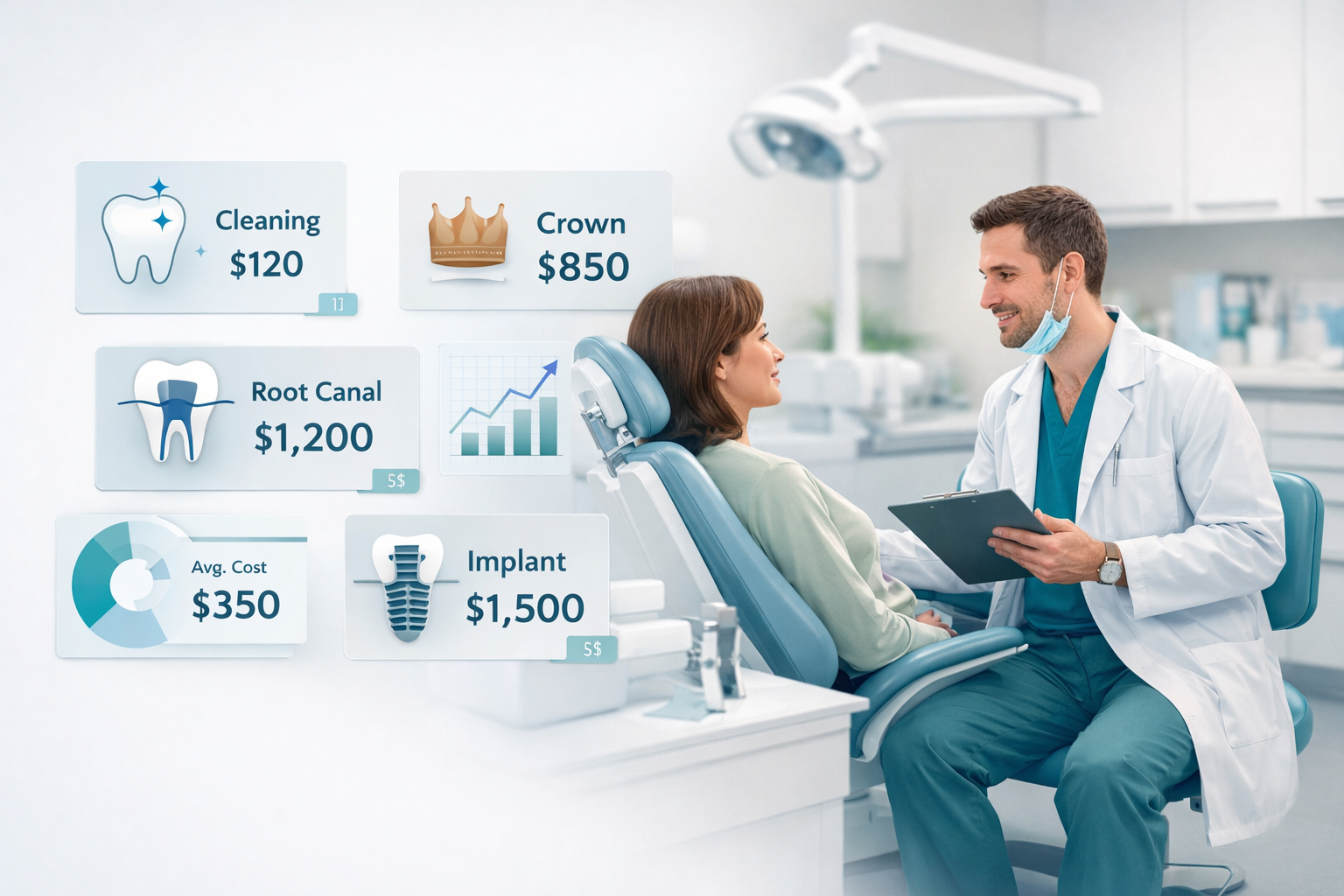
Dental care is one of the most underbudgeted health expenses in America. Survey after survey reveals the same pattern: millions of people delay or avoid the dentist not because they don’t want to go, but because they genuinely don’t know what it will cost. That uncertainty, the fear of sitting down in a dental chair and being handed a bill you didn’t see coming, keeps more Americans away from dental offices than pain, time, or inconvenience combined.
This guide exists to eliminate that uncertainty entirely. Whether you’re searching for the average cost to see a dentist for a routine cleaning, trying to figure out what a root canal costs without insurance, or looking for the most affordable dental care options near you, you will find exact, current, data-backed answers here.
We’ll cover every major dental procedure, break down costs by city and insurance status, explain what drives those differences, and show you how DenScore helps patients across all 50 states find high-quality dental care at prices they can actually afford.
The True Cost of Seeing a Dentist in 2026
There is no single answer to ‘how much does a dentist cost’ because dental care spans an enormous range — from a free annual cleaning covered entirely by your insurance to a full-mouth reconstruction running $30,000 or more. What matters is understanding the specific costs tied to specific procedures, and how your insurance status, location, and choice of provider affect what you actually pay.
The table below is the most comprehensive dental cost reference available for U.S. patients in 2026. Every figure reflects current national averages drawn from DenScore’s network of over 55,000 verified providers across all 50 states. Use it as your baseline — then we’ll walk through what drives variation from there.
Here’s the Cost Table:
| Procedure | National Avg. (With Insurance) | National Avg. (No Insurance) | DenScore Network Avg. |
|---|---|---|---|
| Routine Cleaning (Adult Prophylaxis) | $0 – $35 | $85 – $200 | $110 |
| Periodic Oral Exam | $0 – $20 | $50 – $150 | $75 |
| Full-Mouth X-Rays (FMX) | $0 – $25 | $100 – $300 | $155 |
| Bitewing X-Rays (4 films) | $0 – $15 | $35 – $150 | $65 |
| Single-Surface Composite Filling | $25 – $75 | $120 – $250 | $165 |
| Multi-Surface Composite Filling | $50 – $120 | $200 – $350 | $255 |
| Simple Tooth Extraction | $50 – $110 | $130 – $400 | $200 |
| Surgical Extraction (Impacted) | $150 – $400 | $300 – $800 | $510 |
| Root Canal — Front Tooth | $150 – $350 | $500 – $1,000 | $680 |
| Root Canal — Molar | $200 – $500 | $800 – $1,500 | $1,020 |
| Dental Crown (Porcelain-Fused) | $150 – $450 | $800 – $2,000 | $1,150 |
| Porcelain Veneer (Single Tooth) | Not covered | $900 – $2,500 | $1,400 |
| Dental Implant (Complete, Single) | $500 – $1,500 | $3,000 – $5,500 | $3,900 |
| Full Dentures (Upper or Lower) | $400 – $1,200 | $1,200 – $3,500 | $2,100 |
| Invisalign / Clear Aligner Tx | $1,000 – $2,500 | $3,000 – $8,500 | $4,500 |
| In-Office Teeth Whitening | Not covered | $300 – $800 | $480 |
| Deep Cleaning (Full Mouth, SRP) | $150 – $500 | $600 – $2,000 | $1,100 |
| Night Guard (Custom, Hard) | $100 – $250 | $400 – $800 | $490 |
What Does a Routine Dentist Visit Actually Cost?
For the majority of adults, a routine dentist visit means a cleaning, an exam, and possibly dental X-rays. This is the most common type of dental appointment, the one most insurance plans cover most generously, and the one that causes the most confusion about cost.
Here is a clear breakdown of what each component of a routine visit costs in 2026:
Adult Prophylaxis (Cleaning)
A standard adult cleaning — known in dental billing as prophylaxis, procedure code D1110 — involves removing plaque and tartar, polishing the tooth surfaces, and checking gum tissue. For patients with dental insurance, this is typically covered at 100%, meaning your out-of-pocket cost is zero or minimal. Without insurance, the national average ranges from $85 to $200 depending on your city.
Most dental plans cover two prophylaxis appointments per year. If your plan is active and you’re seeing an in-network dentist, there should be no cost to you for this visit. If you haven’t used your covered cleanings this year, you are leaving real money on the table.
Comprehensive and Periodic Oral Exam
A new patient exam (D0150) is more thorough than the routine periodic exam (D0120) a returning patient receives. New patient exams take longer, involve a full assessment of every tooth, gum, and oral tissue, and set the baseline record for all future care. Most plans cover both at 100% when in-network. Without insurance, a new patient comprehensive exam runs $75 to $150; a periodic exam for returning patients runs $50 to $100.
Digital X-Rays
X-rays are not optional in a thorough dental exam — they reveal what the naked eye cannot, including decay between teeth, bone loss, impacted teeth, infections, and early-stage pathology. Bitewing X-rays (D0274, four films) are the most common and cost $35 to $150 without insurance. Full-mouth X-rays (D0210, 18+ films) are taken at new patient visits and periodically thereafter, running $100 to $300 out of pocket. Most insurance plans cover these annually or every 2–3 years.
Cost of Common Dental Procedures: What to Expect
Beyond routine care, dental costs vary most dramatically for restorative and specialty procedures. Understanding what these procedures cost — and what drives those costs — helps you plan, budget, and avoid financial surprises.
Dental Fillings
A filling is needed when a cavity has formed and the decayed tooth structure must be removed and replaced. The cost of a filling depends on two things: the material used (composite resin is standard today; amalgam is less common) and the number of tooth surfaces involved. A small single-surface cavity costs less than a three-surface filling in a molar.
Composite fillings run from $120 to $250 per tooth for a simple filling without insurance. Multi-surface fillings in back teeth range from $200 to $350. With insurance covering 70 to 80 percent of basic restorative procedures, your out-of-pocket typically falls to $25 to $100. Amalgam fillings are slightly cheaper but are declining in use due to aesthetic and material concerns.
Leaving a cavity untreated is always the most expensive decision. A small cavity requiring a $150 filling will, if ignored, eventually require a root canal and crown — a $2,000 to $3,500 treatment for the same tooth.
Tooth Extractions
Simple extractions — where the tooth is visible and can be removed with forceps — cost $130 to $400 without insurance. Surgical extractions, which require cutting gum tissue or removing bone to access an impacted tooth, run $300 to $800 per tooth. Wisdom tooth removal involving all four impacted teeth under sedation can reach $1,500 to $3,000 at many practices.
Insurance coverage for extractions typically falls under the ‘basic’ category, meaning plans pay 70 to 80 percent. Most patients pay $50 to $150 out of pocket for a simple extraction when in-network.
Root Canal Treatment
Root canal therapy addresses infection or severe damage inside the tooth. The procedure involves removing the damaged pulp, cleaning and shaping the root canals, and sealing the tooth. A root canal on a front tooth costs $500 to $1,000 without insurance; a molar root canal, which is more complex due to multiple canals, costs $800 to $1,500.
Root canals fall under ‘major’ restorative care in most insurance plans, covered at 50 percent after your deductible. That means even with insurance, a molar root canal can cost you $400 to $750 out of pocket — and that’s before the cost of the crown that’s typically needed afterward.
Dental Crowns
A crown — a tooth-shaped cap that covers a damaged or root-canaled tooth — is one of the most commonly needed and highest-cost routine dental procedures. Porcelain-fused crowns run $800 to $2,000 per tooth without insurance. Full zirconia or all-ceramic crowns can cost more. With major insurance coverage at 50 percent, expect to pay $400 to $1,000 out of pocket per crown, depending on your plan’s annual maximum.
Same-day crowns milled using CAD/CAM (CEREC) technology are now available at many modern dental offices. They cost similarly but eliminate the need for a temporary crown and a second visit — a significant convenience benefit that reduces total treatment time from two weeks to one appointment.
Dental Implants
A dental implant — a titanium post surgically placed into the jawbone to support a crown — is the gold standard for replacing a missing tooth. A complete single implant (surgical placement, abutment, and crown) typically costs $3,000 to $5,500 without insurance. Most dental plans either exclude implants entirely or offer limited coverage ($500 to $1,500 lifetime), making out-of-pocket costs significant for most patients.
Implant costs vary by city more than any other procedure. In New York, a single implant can exceed $6,000. In a mid-size Southern city, the same procedure may run $2,500 to $3,500. DenScore’s cost comparison tool lets you see implant pricing across dental offices near you before committing to any provider.
Orthodontics
Traditional braces run $3,000 to $7,000 for a full treatment course. Clear aligner systems like Invisalign cost $3,000 to $8,500 depending on case complexity. Orthodontic coverage, when included in dental plans, typically has a lifetime maximum of $1,000 to $2,500 — leaving families to cover the majority out of pocket. Payment plans are standard practice at orthodontic offices and should always be requested.
Dental Costs by City: How Much More Do Urban Patients Pay?
Where you live affects what you pay at the dentist more than almost any other factor — more than your insurance status, more than the type of procedure, and far more than which dentist you choose within your city. Dental practices in high-cost-of-living metro areas charge more to cover higher rent, staff wages, and operating expenses. The variation is significant.
| City / Metro Area | Avg. Cleaning Cost | Avg. Filling Cost | Avg. Crown Cost | Relative Cost Index |
|---|---|---|---|---|
| New York, NY | $160 – $260 | $250 – $400 | $1,400 – $2,200 | High (+45%) |
| San Francisco, CA | $155 – $250 | $240 – $380 | $1,350 – $2,100 | High (+40%) |
| Los Angeles, CA | $130 – $220 | $200 – $340 | $1,100 – $1,900 | High (+25%) |
| Boston, MA | $135 – $225 | $210 – $350 | $1,150 – $1,950 | High (+28%) |
| Chicago, IL | $115 – $195 | $180 – $310 | $950 – $1,700 | Moderate (+10%) |
| Washington, DC | $125 – $215 | $200 – $335 | $1,050 – $1,850 | High (+20%) |
| Houston, TX | $95 – $170 | $155 – $280 | $850 – $1,550 | Moderate (+5%) |
| Dallas, TX | $90 – $165 | $150 – $270 | $820 – $1,500 | Near Average |
| Phoenix, AZ | $88 – $160 | $145 – $260 | $800 – $1,450 | Near Average |
| Atlanta, GA | $85 – $155 | $140 – $255 | $790 – $1,400 | Near Average |
| Denver, CO | $100 – $175 | $160 – $285 | $870 – $1,575 | Slightly High |
| Miami, FL | $105 – $185 | $170 – $300 | $920 – $1,650 | Moderate (+12%) |
| Nashville, TN | $78 – $145 | $130 – $235 | $740 – $1,350 | Below Average |
| Columbus, OH | $72 – $135 | $120 – $220 | $700 – $1,250 | Below Average |
| Rural Midwest / South | $55 – $110 | $90 – $185 | $550 – $1,050 | Low (-25%) |
These figures represent averages. Individual practices within each city will vary. A high-volume dental chain in downtown Manhattan may charge $300 for a cleaning; a solo practitioner two miles away may charge $160 for the same procedure with equivalent quality. DenScore’s cost transparency feature lets you compare actual pricing across every dental office in your area — the only platform in the U.S. that combines cost data with verified patient ratings.
How Dental Insurance Works — And What It Actually Covers
Most Americans who have dental insurance significantly overestimate how much it covers. The standard dental PPO plan is structured around three tiers, each with a different coverage percentage — and most plans have an annual maximum benefit of $1,000 to $2,000. Once you hit that ceiling, you’re paying 100 percent out of pocket for the rest of the year, regardless of your premium.
| Insurance Tier | What It Covers | Your Typical Out-of-Pocket | Best For |
|---|---|---|---|
| Preventive (100%) | Cleanings, exams, X-rays | $0 – $30 per visit | Everyone — use this fully |
| Basic Restorative (70–80%) | Fillings, simple extractions | $25 – $100 per procedure | Patients needing fillings |
| Major Restorative (50%) | Crowns, bridges, root canals | $400 – $1,000+ per procedure | Patients needing complex work |
| Orthodontic (up to 50%, lifetime max) | Braces, clear aligners | $1,500 – $3,000+ total | Children and some adults |
| Cosmetic (0% — not covered) | Whitening, veneers | Full out-of-pocket cost | Patients seeking aesthetics |
These figures represent averages. Individual practices within each city will vary. A high-volume dental chain in downtown Manhattan may charge $300 for a cleaning; a solo practitioner two miles away may charge $160 for the same procedure with equivalent quality. DenScore’s cost transparency feature lets you compare actual pricing across every dental office in your area — the only platform in the U.S. that combines cost data with verified patient ratings.
How Dental Insurance Works — And What It Actually Covers
Most Americans who have dental insurance significantly overestimate how much it covers. The standard dental PPO plan is structured around three tiers, each with a different coverage percentage — and most plans have an annual maximum benefit of $1,000 to $2,000. Once you hit that ceiling, you’re paying 100 percent out of pocket for the rest of the year, regardless of your premium.
Actual Coverage Table:
| Insurance Tier | What It Covers | Your Typical Out-of-Pocket | Best For |
|---|---|---|---|
| Preventive (100%) | ✓ Cleanings ✓ Exams ✓ X-rays |
✓ $0 – $30 per visit | ✓ Everyone — use this fully |
| Basic Restorative (70–80%) | ✓ Fillings ✓ Simple extractions |
✓ $25 – $100 per procedure | ✓ Patients needing fillings |
| Major Restorative (50%) | ✓ Crowns ✓ Bridges ✓ Root canals |
✓ $400 – $1,000+ per procedure | ✓ Patients needing complex work |
| Orthodontic (up to 50%) | ✓ Braces ✓ Clear aligners |
✓ $1,500 – $3,000+ total | ✓ Children and some adults |
| Cosmetic (0% — not covered) | ✓ Whitening ✓ Veneers |
✓ Full out-of-pocket cost | ✓ Patients seeking aesthetics |
The math reveals a structural reality: dental insurance functions best as a discount and preventive care program, not as comprehensive coverage for major procedures. If you need a root canal and crown in the same year — two procedures that easily total $2,500 to $3,500 — your $1,500 annual maximum may cover only $750 at 50 percent, leaving you with $1,750 to $2,750 out of pocket after exhausting your entire annual benefit.
This is not a reason to avoid dental insurance. Preventive care covered at 100 percent is genuinely valuable. But understanding how coverage tiers work allows you to plan realistically, use your benefits strategically, and not be blindsided by major treatment costs.
How to Get Quality Dental Care at Affordable Prices
Cost should never be the reason someone avoids necessary dental care. Here is a comprehensive guide to the resources available to Americans seeking affordable or low-cost dental treatment near them, ranked from most accessible to most specialized.
1. Use Your Existing Insurance Benefits Fully
If you have dental insurance and are not seeing an in-network dentist twice a year for cleanings and exams, you are paying premiums for benefits you’re not receiving. Two covered cleanings per year at zero out-of-pocket cost is the single highest-return dental benefit available to insured Americans. Use it every year without exception.
2. Dental Discount and In-House Savings Plans
For uninsured or underinsured patients, dental savings plans are the most accessible and highest-value alternative to traditional insurance. These plans — offered directly by dental practices — cost $150 to $400 per year and typically include two free cleanings, one set of X-rays, and discounts of 15 to 30 percent on all other services. Unlike insurance, there are no waiting periods, no annual maximums, and no claim denials.
DenScore’s search includes a filter specifically for practices offering in-house savings plans. If you’re uninsured and looking for affordable dental care near you, this is where to start.
3. Federally Qualified Health Centers (FQHCs)
Federally Qualified Health Centers receive federal funding to provide dental and medical care to underserved populations on a sliding fee scale. Cost is based on your income — families at or below the federal poverty level may pay as little as $20 to $40 for a cleaning and exam. There are over 1,400 FQHCs operating more than 14,000 service sites across the United States.
To find an FQHC near you, visit findahealthcenter.hrsa.gov or use DenScore’s ‘Low-Cost Options’ filter. These are real dental offices — not pop-up clinics — staffed by licensed dentists providing quality care.
4. Accredited Dental School Clinics
The 66 ADA-accredited dental schools in the United States operate patient clinics where supervised dental students and residents provide care at 40 to 70 percent below private practice rates. The trade-off is time — appointments can run longer, and scheduling may take several weeks. The quality, however, is supervised and rigorously evaluated. For non-urgent procedures, dental school clinics represent the best combination of cost and quality available to any patient regardless of insurance status.
Major cities with highly regarded dental school clinics include New York (NYU and Columbia), Los Angeles (UCLA and USC), Chicago (UIC), Houston (UTHealth), Boston (Tufts, Harvard, and Boston University), and Philadelphia (Temple and Penn).
5. Dental Financing Options
For necessary procedures that exceed what you can pay upfront, most dental offices near you will offer financing through CareCredit, Sunbit, or Proceed Finance. CareCredit offers 0 percent interest for 6, 12, or 18 months depending on the purchase amount. Sunbit is available at the dental office itself and approves the majority of applicants. In-house payment plans are also common for multi-visit treatment plans.
Using 0-percent financing for a root canal and crown rather than delaying treatment is the financially sound decision. Delaying treatment converts a $2,000 procedure into a potential extraction and implant costing $4,000 to $6,000.
6. Compare Dentist Prices Before You Book
Price variation for the same procedure within the same city can range from 30 to 80 percent depending on the practice. A composite filling that costs $280 at one downtown office may cost $165 at a well-reviewed practice five miles away. DenScore is the only dental platform in the United States that displays estimated procedure pricing alongside verified patient ratings and insurance compatibility — letting you make an informed decision on cost without sacrificing quality.
Budgeting for Dental Care: What Americans Should Actually Spend Per Year
Financial planners and dental health organizations offer a range of recommendations on how much to budget for dental care annually. The most accurate answer depends on your current dental health status, insurance coverage, and age. Here is a practical framework:
Adults with Good Dental Health and Insurance
Your two annual cleanings and exams should be $0 to $60 out of pocket. Budget $200 to $400 per year to cover small copays, the occasional filling, and any unexpected procedures. If you have a procedure in a given year, expect to contribute your deductible (typically $50 to $150) before coverage kicks in.
Adults with Active Dental Issues or Limited Insurance
If you have active gum disease, multiple cavities, or older restorations that may need replacement, budget $600 to $1,500 per year. Consider an in-house savings plan if you’re uninsured. Major treatments like root canals or crowns can be deferred strategically if your dentist agrees the tooth is stable — but deferral beyond 3 to 6 months increases risk substantially.
Adults with No Insurance
Without insurance, budget $300 to $500 per year for preventive care alone. Add $500 to $1,500 for one or two minor restorative procedures if needed. Prioritize an in-house savings plan, which will reduce these costs by 15 to 30 percent immediately. Keep an emergency dental fund of at least $1,000 for unexpected urgent treatment.
Families with Children
Children’s dental care is covered under most insurance plans through age 18, and under the ACA marketplace plans through age 18 as an essential health benefit. Out-of-pocket costs for children with insurance are typically low. Budget $100 to $300 per child per year for copays, orthodontic consultations, and any sealant or fluoride treatments not fully covered.
Frequently Asked Questions About Dental Costs
Here are some of the most important questions people ask about dental insurance plans.
How expensive is a dentist visit without insurance?
A routine visit — cleaning, exam, and X-rays — costs $200 to $450 without insurance nationally. In high-cost cities like New York or San Francisco, the same visit can run $450 to $600. For restorative procedures, costs escalate significantly: a filling runs $120 to $350, a root canal $500 to $1,500, and a crown $800 to $2,000.
What is the cheapest fix for bad teeth?
The answer depends on the condition of your teeth. Tooth bonding is the least expensive cosmetic option ($200 to $600 per tooth). Fillings address decay at $120 to $450 per tooth. If multiple teeth need attention simultaneously, a dental school clinic or FQHC can provide treatment at 40 to 70 percent below private practice rates. DenScore’s low-cost filter also surfaces affordable in-network providers near you.
How much should I budget for dental care annually?
i) For an insured adult in good dental health: $200 to $600 per year. ii) For an uninsured adult: $500 to $800 for preventive care and minor restorative work. iii) For adults with active dental issues: $800 to $2,000, depending on the treatment required. Always maintain a dental emergency fund of at least $1,000 for unexpected urgent care.
How much is Aspen Dental without insurance?
Aspen Dental offers an in-house Frist Visit Offer that typically includes a comprehensive exam and X-rays at no cost or low cost for new patients. Without insurance, ongoing care at Aspen Dental is priced similarly to national averages — cleanings run $100 to $180, fillings $150 to $300, and crowns $800 to $1,500. Aspen Dental also offers its own payment plans and accepts CareCredit. For a detailed comparison of Aspen Dental vs. independent local dentists near you.
Does where I live affect what I pay at the dentist?
Yes, where you live significantly impacts dental costs due to variations in overhead, demand, and local competition. Dental costs in high-cost cities like New York, San Francisco, and Boston run 25 to 45 percent above the national average. Costs in rural areas and smaller Midwestern or Southern cities run 20 to 30 percent below average. Use DenScore’s cost comparison tool to see actual pricing in your specific area.
Is dental insurance worth it?
How can I find a dentist near me that charges affordable prices?
Use the DenScore free online dental locator tool, filter by your insurance plan or ‘uninsured,’ and sort by estimated procedure cost. DenScore is the only U.S. dental platform that combines verified cost data with patient ratings — so you find affordable dentists near you without sacrificing quality. Look for a DenScore Rating of 8.5 or above at the lowest price tier in your search results. You can also directly call Dr Kyle Gernhofer (DenScore CEO) and ask for low-cost dentists or dental clinics near your exact location
Stop Guessing. Start Knowing What Your Dental Care Will Cost.
The goal of this guide was to give you clarity — not just rough numbers, but a real understanding of what dental care costs across different procedures, different cities, and different insurance situations. Because when you understand the costs, the decision to take care of your teeth becomes much easier to make.
Preventive care is almost always affordable. Restorative care becomes affordable when you plan for it. And the cost of avoiding the dentist entirely — in treatment bills, lost teeth, and health consequences — is always the highest price of all.
DenScore exists to make the economics of dental care transparent and the search for quality, affordable dentists near you as fast and trustworthy as possible. Every provider in our network is verified, every rating is earned, and every cost estimate is based on real data from real practices.
Find the best affordable dentist near you on DenScore free online dental locator tool, and know exactly what your care will cost before you ever sit in the chair.
🔍 Find Dentist Near Me — Free
✅ 100% Free
🇺🇸 All 50 States
⭐ Verified Reviews
🔒 No Sign-up Needed